
When the Body Tells The Whole Story
A Private Restoration Cleanse for Dryness, Congestion, and the Cost of Overfunctioning
This case study was a private, field-based restoration cleanse with a long-term client who directly inquired about doing this kind of work. Identifying details have been softened or omitted to protect confidentiality while preserving the teaching value of the case.
This was not a spa package or a consumer experience.
The client came in with complaints of congestion, eye pain, physical heaviness, and a sense that something needed to clear. There had also been recent relational and family activation, which tended to stir older survival patterns in the system.
This was not new terrain. Over several years, the work had included long-standing patterns of anxiety, paranoia, hypervigilance, overfunctioning, under-nourishing, overdoing, and managing or absorbing chaos that was not the client’s to carry.
The client’s home life was often chaotic, and part of the deeper work had been helping the client recognize what belonged to the client and what did not. The client was still learning how to remain caring and engaged without treating every disruption nearby as the client’s responsibility to manage.
By the time the client entered the cleanse, the body was not simply asking for symptom relief. It was showing the accumulated cost of years of vigilance, overdoing, disconnection, and insufficient nourishment.
Although the stated concerns were congestion and eye discomfort, the body told a more complete story.
The hands, feet, ears, scalp, hair, and eyes all reflected a deeper pattern: dryness, hardness, strain, and lack of sustained care in the exact areas connected to the complaints.
This was not cosmetic dryness. It was hard, deep, chronic, and known.
It was powerful information.
The body was showing where care had not reached, where support had been refused, and where tending had not been consistently applied.
The Initial Read
The client is vata-dominant, with signs of dryness, nervous system overactivity, mental strain, and difficulty fully settling into support and containment. At the same time, there was also congestion and stagnation present — not as a purely kapha pattern, but as stuckness layered over vata depletion.
This distinction mattered. The stuckness was both systemic and mental/emotional.
A more aggressive cleanse could have provoked vata and created more instability. The first task was not to force clearing. The first task was to settle the system enough that clearing could happen without scattering the client.
The working pattern was:
Dry underneath.
Congested on top.
Overactive outwardly.
Restless inwardly.
Undernourished at the core.
The client’s eyes were a big complaint. But the eyes were not isolated. The client’s refusal to consistently use the glasses needed for phone and close-up vision was reinforcing the problem daily. The eye strain reflected a broader pattern: trying to see, manage, and function without accepting the support required as well as refusing to see. There was also dryness.
The hands, feet, and ears confirmed the larger picture.
In reflex and field-mapping systems, these areas correspond to the whole body. They are not peripheral. They are access points. Maps.
The hands reflected doing, holding, managing, and overuse. This was especially clear because the client had undergone surgery earlier in the year, and the surgical scar had become thickened, hardened, and less pliable. The area had not been sufficiently tended after surgery. The scar itself became part of the read: a place where the body had healed structurally, but where softness, circulation, and full integration still needed support it was not getting.
The feet reflected grounding, elimination, support, and the body’s relationship to rest and earth. The client was aware that the feet needed care, which made the neglect even more significant. When the places that ground and carry us are repeatedly untended, the consequences are not only physical.
The ears reflected vata, nervous system sensitivity, receptivity, hypervigilant listening, and subtle listening.
All three were dry, hard, and under-tended.
They showed some of the reasons for the basic complaints.
The Treatment Logic
The container was structured around a simple principle:
Settle vata first without provoking kapha.
The body needed warmth, oil, rhythm, containment, and rest — but not heaviness, indulgence, or stagnation.
The structure itself was an important part of the treatment. With vata dominance, long-standing hypervigilance, overfunctioning, and patterns that had been understood for years but not yet fully embodied, the body needed more than insight. It needed rhythm. It needed repetition. It needed containment. It needed the lived experience of being held inside a simple, steady structure long enough for the system to respond differently.
This was part of the reason the work continued beyond verbal processing. The patterns were known, but knowing was not the same as embodiment. The cleanse created a physical, energetic, and relational container where the body could begin to experience what the mind had already been shown.
The work included:
Warm oil application
Head pichu
Pichu placement at the neck and throat
Vibrating heat over pichu placement
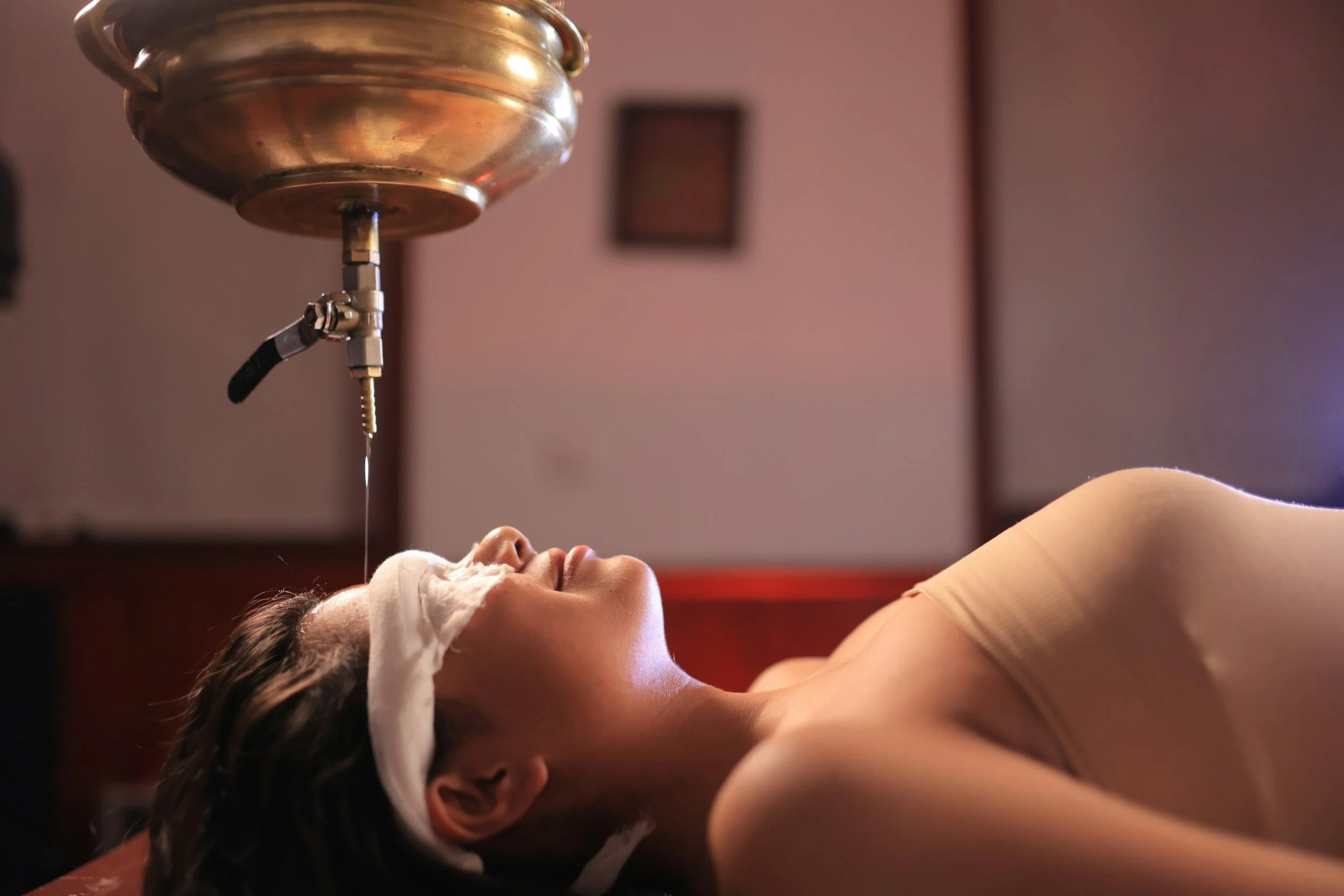
Shirodhara
Kansa wand work
Daily ginger compresses with hot pack support
Mineral mud
Sauna with light steam
Triphala gargle
Triphala eye wash when appropriate
Oil pulling
Kitchari
Rest
Hands-on field work when indicated
Verbal integration as needed
The treatments were not chosen from a menu. Each day was guided by what the body, nervous system, and field were presenting.
Some days required more movement. Other days required more quiet. Some days called for verbal integration. Other days needed silence, oil, food, and rest.
The goal was not to do more.
In many ways, the goal was to do less.
Less managing.
Less forcing.
Less stimulation.
Less outward tending.
Less interference.
The deeper goal was to do what was indicated.
Hands, Feet, Ears, Scalp, and Hair
These areas provide access to and information about the entire system. Treating them first allowed the entire system to be acknowledged. The hands, feet, ears, scalp, hair, and eyes were all saying the same thing in different ways:
I have been over-used.
I have been strained.
I have been overlooked and ignored.
I have not been properly tended.
The work was not simply to cleanse. It was to restore care to the places that had been neglected.
Shirodhara as a Central Treatment
Shirodhara is an important treatment for balancing vata. It involves a stream of warm oil on the forehead. It is a profoundly settling and calming treatment.
During the first four days, one shirodhara treatment was given. At least two additional shirodhara treatments were planned for the next phase of treatment, once the body had been further prepared through oiling, warmth, pichu, ginger compresses, rest, and nourishment.
The Eyes and the Pattern of Refusing Support
The client agreed that the eyes were strained from not wearing the glasses needed to support clear vision.
This was significant.
The eye complaint was not only about the eyes. It also revealed a long-standing pattern in the client’s relationship with the body: focusing on what was wrong with the body rather than where the client was out of relationship, balance, or cooperation with the body.
The eyes were not simply malfunctioning. They were being asked to compensate.
There was strain from trying to see without the support required. There was dryness. There was fatigue. There was the daily reinforcement of forcing the eyes to do work they could not comfortably do without help.
Once the client acknowledged the strain, the client could begin to participate differently. The question shifted from “What is wrong with my eyes?” to “Where am I refusing the support my eyes need?”
That shift mattered.
The eye support included gentle external soothing, triphala eye wash when appropriate, traditional ghee-based eye support, reduced screen time, rest, and the clear instruction to use the glasses needed for phone and close-up vision.
The teaching was simple:
Refusing support and refusing to see requires compensation. Compensation creates strain. Strain becomes pain.
The deeper invitation was not only to treat the eyes.
It was to restore relationship with them.
Treatment Response Over the First Four Days
The client was profoundly exhausted at the beginning of the cleanse.
On the first day, the client slept for approximately four hours after treatment, then drove home, ate, and went straight to bed. The next day, the client slept for approximately three hours after treatment and again went home, ate, and went to bed.
This level of sleep and collapse into rest was significant. It suggested that the body was not simply relaxing. It was exhausted and taking the opportunity to repair, digest, and recover from a level of depletion that had likely been present for some time. The client often came into session in this kind of exhausted state.
By the third day, there was more energy available. The system was still processing, but there was a shift from collapse into rest toward more usable vitality.
By the fourth day, the client was hungry — strongly hungry. This was useful information. The client’s appetite returning suggested that the digestive fire was waking up and that the body was beginning to ask for nourishment rather than merely sedation, depletion, or relief.
This progression mattered:
Day 1: profound exhaustion and sleep.
Day 2: continued deep rest.
Day 3: more energy available.
Day 4: strong hunger and visible transformation.
The body was not being forced into change. It was responding to care, rhythm, warmth, oil, food, and rest.

The Visible Shift
By the fourth day, the client looked completely different.
The face softened. The hair transformed. The body softened and appeared more nourished. The nervous system felt less defended. The client felt good, was easy going and kind and the changes were visible enough that the client and the client’s partner were deeply impressed.
The transformation was not from one treatment alone. It came from the combination of:
Daily rhythm
Oil
Hydration
Heat
Food
Rest
Field work
Reduced outward demand
Attention to neglected areas
Proper preparation before deeper treatments
Care reaching the places that had been ignored
The body responded quickly because it had been waiting for this kind of care.
What The Pause Revealed
After four days, the client asked to extend the immersion after a pause. The client had originally committed to five treatment days, but the visible and felt shifts were significant enough that the client chose to add three more days.
The structure became four treatment days, followed by a pause, followed by additional 4 treatment days.
The pause became part of the work. It became information.
Inside a daily container, a client can feel dramatically better. The deeper question is what happens during the pause, when they return home and are no longer inside the daily rhythm of treatment, food, rest, and containment.
What holds?
What slips?
What starts to harden, dry out, or scatter again?
What old pattern resumes?
The pause gives useful information. It shows whether the system can protect what changed when it is no longer being held by daily treatment.
This is especially important for clients with long-standing overfunctioning patterns. The work is not complete simply because the person feels better inside the container. The work has to be protected when ordinary life resumes.
When Relief Is Mistaken for Completion
One of the deeper teachings of this case is that relief is not the same as resolution or completion. And containment serves a real, important purpose.
Feeling better can be the moment when the system is finally resourced enough to continue, stabilize, and integrate. But for clients with strong patterns of overfunctioning, resistance, avoidance, or self-directed chaos, feeling better may also become the moment they move away from the structure that helped them. That is what happened in this case.
This is not a failure of the treatment.
It is the pattern reestablishing itself.
The body may respond quickly. The nervous system may soften. The face may change. The appetite may return. The client may feel lighter, clearer, and more alive.
But the deeper question remains:
Can the client protect the shift once the immediate relief arrives?
That is where integration lives.
Core Insight
The most important insight from this case was that the client’s complaints were not isolated.
The body was showing a system-wide pattern of insufficient care, disrupted relationship, and known neglect in the exact places connected to the symptoms.
This was not simply physical neglect.
It reflected a deeper pattern of being out of relationship with the body: noticing what was wrong, but not consistently responding to what was needed. The body had been treated more as a problem to manage than as a living intelligence asking for cooperation, support, nourishment, and care.
The dryness and hardness in the hands, feet, ears, scalp, hair, and eyes revealed the central pattern:
The places most responsible for seeing, hearing, holding, doing, grounding, and moving through life had not been receiving the care required to keep functioning well.
The consequences of that neglect were significant.
When the hands are overused and under-tended, doing becomes strained.
When the feet are hardened and neglected, grounding and elimination are affected.
When the ears are dry and the nervous system is hypervigilant, listening becomes distorted.
When the scalp and hair are depleted, the whole head field is under-supported.
When the eyes are strained, dry, and denied the support they need, seeing becomes painful.
The body was not betraying the client.
The body was reporting the truth.
Care had not reached the places doing the work.
The treatment was not only about clearing congestion. It was about restoring relationship: softness where there was hardness, nourishment where there was depletion, circulation where there was stagnation, receptivity where there was resistance, and support where compensation had become the norm.
What This Case Revealed
This case revealed that congestion is not always a sign of excess alone. Sometimes what looks like congestion is stagnation layered over depletion. In a vata-dominant system, aggressive clearing can scatter the system further if the body has not first been settled, warmed, oiled, and contained.
It also revealed how clearly the body speaks through neglected places. The hands, feet, ears, scalp, hair, and eyes were not incidental. They showed where care had not reached and where compensation had become the norm.
The work also showed that support has to become practical. It is not enough to understand that the eyes are strained. The client has to use the glasses. It is not enough to receive care inside a container and then return immediately to the same patterns of overfunctioning. The daily relationship with the body has to change.
More is not always better. The right treatment at the right time is more powerful than doing everything at once. Shirodhara needs space. Eye support needs gentleness. Clearing needs preparation. Integration needs quiet.
And finally, feeling better is not the same as lasting change. Feeling better may mean the system is responding. It does not necessarily mean the work has been embodied. For change to last, the client must protect what has shifted and interrupt the patterns that created the depletion.
Practitioner Reflection
This container also unfolded while I was recovering from a significant hand and wrist injury. That became part of the work in a quiet but important way.
Rather than pushing harder or relying on force, my own recovery required more precision, pacing, and listening through the hands. The treatments asked for discernment: when to use hands-on field work, when to let heat and oil do the work, when to use pichu as a bridge, and when to stop.
The client could feel the change in the hands-on work. At one point, so much was moving that she asked me to stop. That moment became useful information for both of us. It confirmed that the work needed structure, pacing, and integration — not intensity for its own sake.
In that way, the practitioner’s recovery and the client’s restoration were not separate from the intelligence of the container. The work became more precise, not more forceful.
Closing Reflection
The body was not asking for more effort.
It was asking for care to finally arrive where it was needed.
This work was about restoring relationship with the places that had been carrying the burden: the hands, the feet, the ears, the scalp, the eyes, the food, the rest, and the willingness to receive.
When care reached those places, the body responded.