
I was not prepared for the condition of my hand.
As far as I understood it, I had scraped the top of it when I fell. It had happened so fast that I fell on top of my hand. But the hand itself did not seem like the main site of injury.
The break was in the arm, near the wrist.
The surgery was in the arm and wrist.
The fracture and dislocation were the obvious story.
What I did not understand was that the hand would end up living so much of the aftermath.
My hand looked dead. During surgery, a tourniquet had been used above the elbow to control bleeding. My entire arm was badly bruised. The soft tissue damage was extensive.
I was not prepared for the swelling that took over my fingers.
I was not prepared for the stiffness that made my hand feel foreign.
I was not prepared for the weakness, the loss of grip, the lack of mobility, the hours of therapy, or the strange intimacy of realizing how much of daily life depends on something as ordinary and miraculous as a functioning hand.
Because the hand is not incidental.
The hand is how we do life.
It is how we touch, hold, clean, cook, cut, carry, drive, gesture, tend, and make contact with the world.
It is how we manage ourselves.
How we care for ourselves and others.
How we continue.
So when the hand becomes swollen, weak, stiff, and unreliable, the disruption is not abstract.
It is immediate.
It is constant.
It is intimate.
This injury did not just change what I could do. It changed how I moved through the most ordinary parts of life. And that is humbling at a deep level.
Bathing became a challenge.
Dressing myself became a challenge.
Preparing food became a challenge, especially anything that involved cutting.
Sleeping became a nightly negotiation with discomfort and positioning.
Driving changed.
Grip changed.
Strength changed.
Even the simplest tasks became deliberate.
These are not dramatic details. They are the truth of what it means when the hand becomes almost non-functional.
And maybe that is part of why this has been so confronting.
Because what I was being asked to do, whether I liked it or not, was stop.
Not symbolically.
Not in some poetic, spiritualized, “slow down and receive the lesson” kind of way.
Actually stop.
I could not simply continue doing what I normally do and adjust around it.
I could not over-function my way out of this.
I could not force the hand to be ready before it was ready.
I could not bypass the reality of swelling, weakness, stiffness, and loss of function.
I could not just push through it like I had so many other things. Including breaking my back.
The hand would not allow it.
And therapy was the next hurdle to cross.
From the beginning, therapy was framed to me as something I would have to push through. Something painful. Something forceful. Something I was supposed to endure if I wanted my function back.
There was an implication that progress would come through intensity. That I should be able to do certain things, like make a fist, by a certain time, regardless of the actual details of my injury.
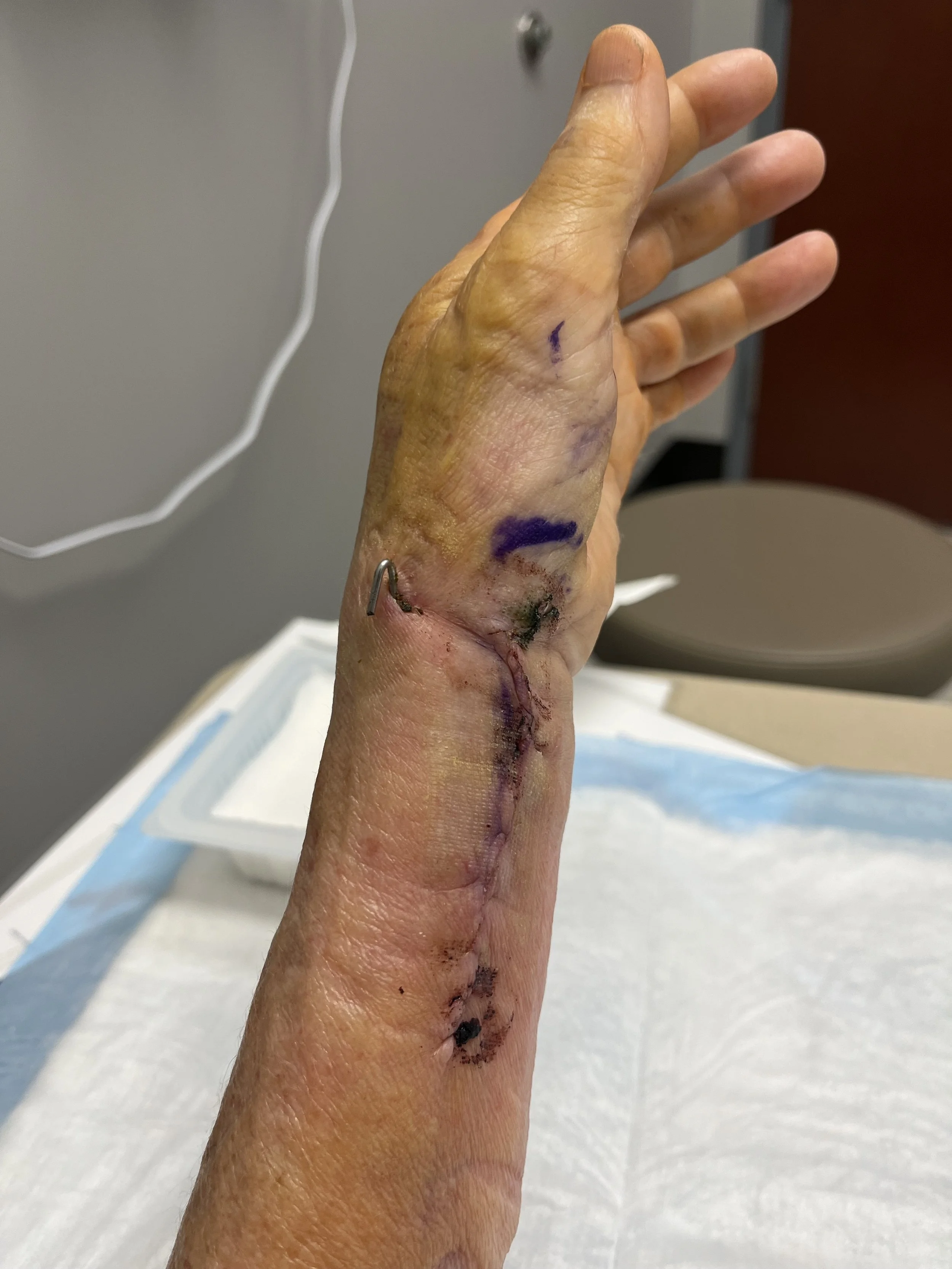
But my hand was telling a different story.
My hand was swollen. Stiff. Tender. Shocked.
It did not need to be bullied back into function.
It needed skill.
It needed patience.
It needed consistency.
It needed respect.
That became one of the clearest teachings of this injury: you can't always use force to deal with force.
Pain is not always proof that something useful is happening.
And overriding the body is not the same thing as rehabilitation.
That has been part of the ordeal.
Not just the pain.
Not just the inconvenience.
Not just the injury itself.
But the enforced interruption.
The requirement that I give up normalcy.
The requirement that I work around slowness, limitation, and dependence in ways I did not choose and certainly did not welcome.
And the requirement that I discern the difference between effort and force.
The difference between discipline and aggression.
The difference between showing up consistently and turning recovery into another war.
There is something deeply humbling about realizing how much autonomy lives in the hand.
How much dignity.
How much capability.
How much unconscious confidence.
You don’t think about the hand until it becomes difficult to trust it.
Until gripping is uncertain.
Until opening a jar, holding a pan, cutting food, washing your body, or finding a sleeping position becomes effortful and deliberate instead of automatic.
Until the hand becomes a daily reminder that what happened is still happening.
And yet, within all of that, the hand has also become a teacher.
Not because I wanted it to.
Not because I think everything hard needs to be romanticized.
But because this hand has forced me into a relationship with function, patience, adaptation, and reality that I could not sidestep.
It has shown me where I still want to override.
It has shown me how quickly the body becomes a problem to solve when it no longer cooperates on demand.
It has shown me that healing is not only about getting back what was lost.
It is also about learning how to be with what is limited.
How to work with what is available.
How to let function return without turning recovery into a war.
The bones broke near the wrist.
But the hand is living the aftermath.
Not just of the injury.
Of the surgery.
Of the swelling.
Of the dislocation.
Of the immobilization.
Of the long, slow work of returning.
And if I am honest, it is the hand that has taught me most of what I am now learning about force, surrender, and the long intelligence of healing.