
Some journeys rearrange your soul. All my trips to India have been that way.
I was fortunate enough to spend three weeks there this past December. But let me be clear — it was not a vacation. It was tapasya — a time of inner fire, pilgrimage, and profound recalibration.
The travel was challenging, as it often is. But every trip teaches me something that I apply to the next one. And yes — the next trip is always quietly humming in the background of my life. One day I’ll stay longer, and maybe even live there.
Why I Go Back
There is something about the culture — so rich, so full of devotion and simplicity. People aren’t sitting around watching the news, scanning for offense or fault. It’s refreshing.
In the remote region of Andhra Pradesh where the ashram is located, even the cell service is spotty — so people aren’t glued to their phones (if they have them at all). The temple is the main event, not just on Sundays. For many, it’s a natural part of the day. And they show up in their best clothes — radiant, elegant, beautiful.
Even the children understand devotion. Every day begins with God/dess. The sun, water, earth, and sky are honored regularly. Ants are fed before meals. People dress like the deities they worship. It’s not effort. It’s flow.
There is something profoundly elegant about a saree. Even a simple kurta and slacks make a statement that feels more than just aesthetic. As the weather warms here at home, that’s what I’ll wear. Because in India, I felt beautiful.
It made me cry to realize that I haven’t felt that at home in a long time.
I’ll speak more about that in a future post.
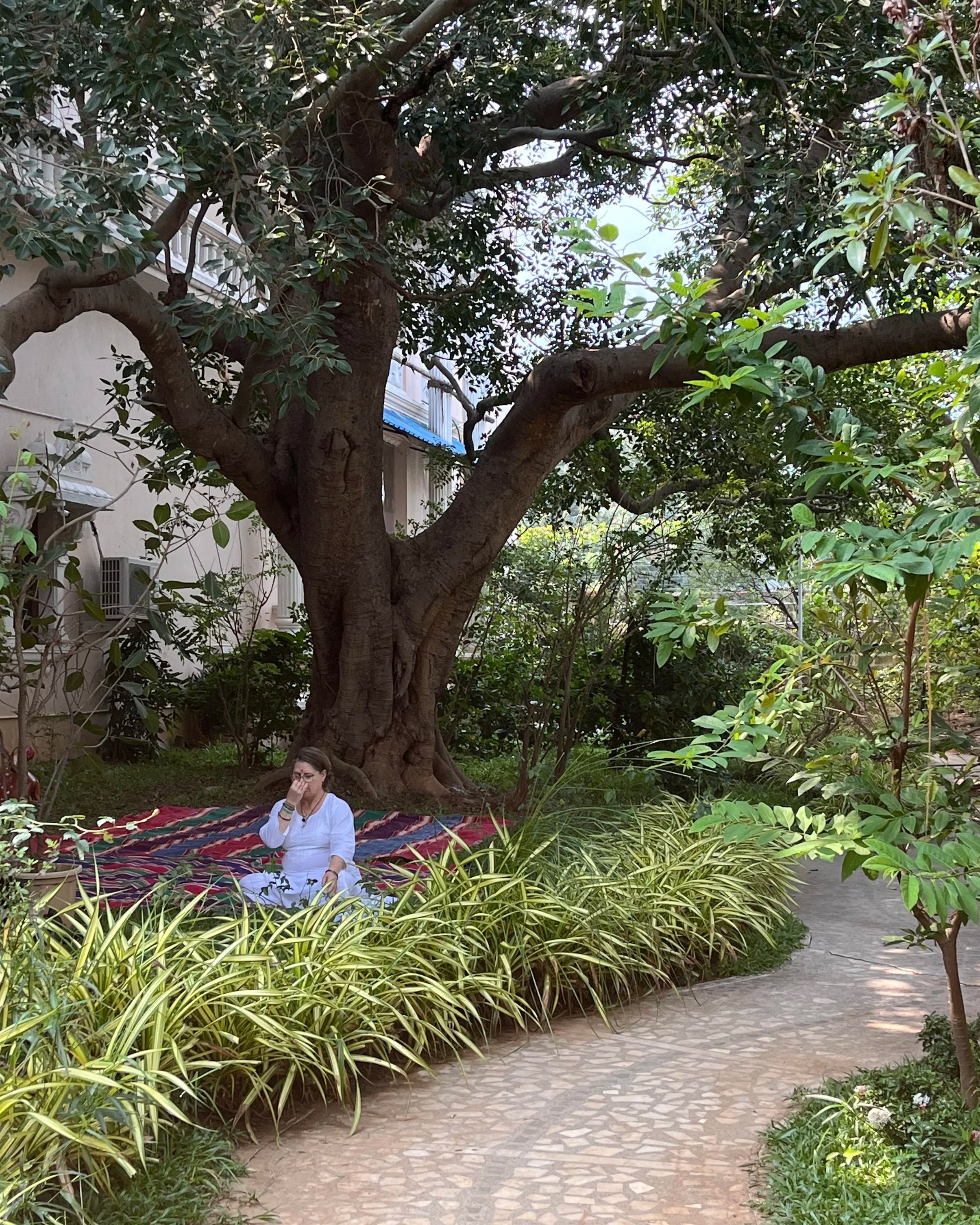
🌺 The Sacred Feminine Is Still Intact There
Another thing I noticed — and felt — was how different the energy around feminine beauty is in India.
Yes, the women are beautiful. Radiant, in fact. They wear color, they adorn themselves, they take pride in their appearance.
But not once did I feel the kind of sexualized, hyper-curated, surgically crafted pressure that is so normalized in the West.
Their clothing was elegant and flowing. Sometimes flashy with embroidery or beadwork, yes — but never tight, never performative.
No fake lashes. No fillers. No filtered faces or stylized pouts.
Just beauty that came from devotion, from lineage, from sacred rhythm.
They weren’t trying to look like goddesses.
They already knew they were.
It reminded me again how much we've lost — and how much we have to learn.
The First Morning in the Temple
My first day in the temple cracked something open.
I had a very deep experience — one I still don’t have full words for.
The devotion of the priests — these young Indian men offering themselves with such purity and grace — touched something tender in me. I was immediately aware of how absent this kind of daily sacred experience was in my own life. Not this depth. Not this certainty.
And I cried. I don’t know how long. I only know that something in me recognized this life as the one I long for.
When I eventually came back to the room around me, I noticed a small bowl of prasad sitting quietly on my cushion — with a single flower in it.
It felt like a response. Like the Goddess was saying, “I see you.”
It took me a little while to gather myself. I did so just in time to walk to the 10am fire ceremony, still raw and wide open.
And the fire — as always — met me where I was.
What Is Tapas?
In yogic tradition, tapas means heat — austerity, discipline, or inner fire. It burns away impurities, negative patterns, karmic seeds and unconscious obstacles. Tapas clears the path toward dharma — not through striving, but through conscious choice.
It’s not about punishment. It’s about self-realization through spiritual consistency — doing what leads to growth rather than giving in to ease or compulsion.
The ashram schedule was not fluffy. It wasn’t rigid either — but there was no confusion about what was suggested.
The Daily Rhythm
3:00 AM. Wake up and meditate. This aligns with Brahma Muhurta, the “time of the Creator,” said to be the most powerful time to pray, meditate, and align with universal consciousness.
5:00 AM. The temple opens. India is not quiet in the mornings — devotional chanting begins over loudspeakers even earlier some days.
6:30 AM. One of the priests leads a Ganesh ritual. We all participate. Ganesh, remover of obstacles and patron of beginnings, opens the space. That’s followed by a Surya (sun) ritual and prasad, blessed food.
I can’t think of a better way to honor the day.
And I always went to the temple afterward, because more chanting and rituals were unfolding — and I couldn’t get enough of it.
9:00 AM. Breakfast.
The food at the ashram was intentional — all made from scratch, always soft and easy to digest, deeply nourishing. Amma herself often prepared a soup or dish each day for us. Coffee, tea, and warm milk were served twice daily — though I stopped caffeine while I was there.
10:00 AM. Daily fire ceremony.
I never missed it. Fire ceremonies are among my favorite practices — and these were conducted with precision and love under Amma’s direction, always for our benefit.
11:30 AM. Discourse with Amma.
Held in a magical area of the ashram, these sessions could include chanting, meditation in Her presence (which is unlike anything else), or specific guidance.
Sometimes she’d ask us to write a certain mantra a set number of times. Sometimes we were to wear red, offer bilva leaves, or light a diya (lamp) at the temple. Bilva leaves are considered deeply sacred in Sanatan Dharma. There a many bilva trees on the ashram grounds and we sat under them for meditation.
2:30 PM. Lunch.
Ten to twelve dishes, all freshly cooked. Beyond real description. Nourishing, intentional, digestible.
3:30–5:30 PM. Meditation, personal care, or handling laundry and practical needs.
5:30 PM. More discourse with Amma.
This could include chanting Rudram or other mantras, or simply being in her presence.
8:30 PM. The temple closes after the final ritual of the day — offering ghee lamps and singing of light’s triumph over darkness. It was just as sacred as the beginning of the day.
9:00 PM. Dinner. Then to bed, to rise again at 3am.
The Transformation Was Real
There were nights I was in considerable physical pain. Amma told us She was performing “surgery” on us every day — removing obstacles, clearing karma, and purifying our systems.
All I can say to that is: Wow.
Even now, weeks later, I find myself at a loss for words — because my body feels different. Physically different. Not just lighter or stronger or more open. Something more fundamental.
I don’t know how to describe it exactly. But I know something changed.
Something recalibrated.
It’s as if my body is now aligned to something deeper — a rhythm, a current — and it doesn’t want to go back to the way it was.
I spoke with one of Amma’s senior staff about what I was experiencing. He looked at me with calm knowing and said:
“Tapas is the conscious acceptance of discomfort.”
So I accepted. And it continued.
The Sadness of Leaving
As the time drew near for me and my companion to leave the ashram and continue our pilgrimage to Tiruvannamalai, I was overcome with sadness. I couldn’t stop crying.
Everything made me cry.
I loved the temple and the priests. I loved the simplicity and structure.
I loved that devotion and God/dess were the center of everything — not an afterthought, not a Sunday add-on, not something you read about but something you experienced.
It was all I wanted.
Coming Soon:
Part 2 — The Mountain That Burned Me Clean: Tiruvannamalai
Where silence hums through the stones, where fire lives in the mountain, and where I remembered something I didn’t know I’d lost.