
The Mountain That Burned Me Clean
Part 2 of 3: A Pilgrimage into the Fire
After our days at the ashram, it was time to continue the pilgrimage.
We hired a driver to Tiruvannamalai, home of the holy mountain Arunachala — and the next part of a truly life-altering journey.
I had never been before, but my travel companion had.
A Gemini, and a seasoned Tiru walker, he loved being in charge of the agenda — and honestly, I was happy to let him.
We stayed just five minutes from Sri Ramana Maharshi’s ashram, and that was our first stop.
The Feet Know the Way
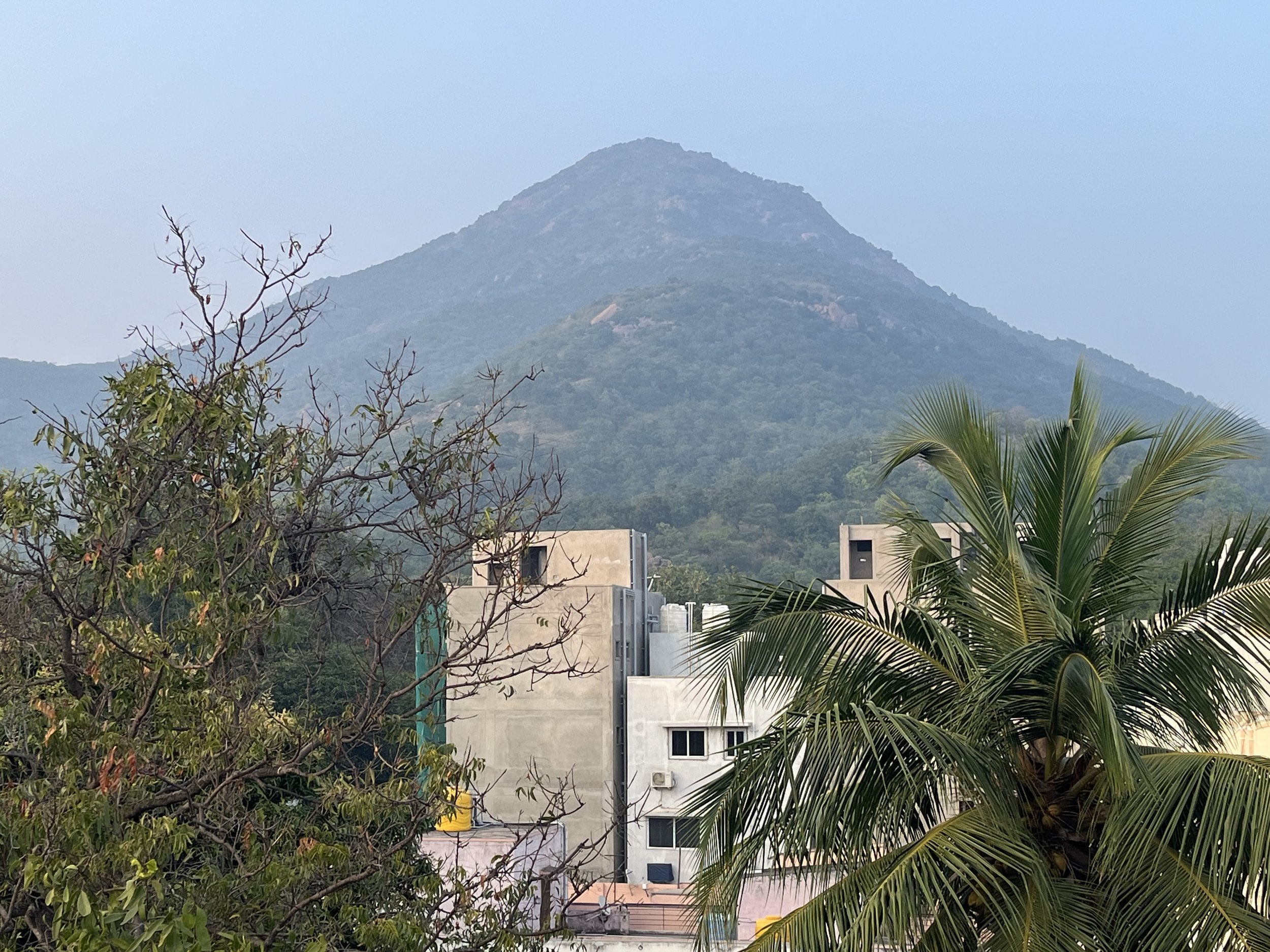
For those unfamiliar, Ramana Maharshi was one of the most revered sages of the 20th century — a teacher of silent presence, radical inquiry, and Self-realization through the question: Who am I? He spent decades living and meditating on the slopes of Arunachala, the mountain he regarded as Shiva himself in the form of stone.
You can’t walk into a store in Tiru without removing your shoes — so naturally, the first thing we did at the ashram was take ours off.
And many people? They never put them back on.
I was stunned by the number of barefoot pilgrims/people — not just elders or babas, but entire families, children, women in sarees, young men in track pants, wandering freely across streets and temples and hot pavement like it was nothing.
Meanwhile, I’m a tender-footed American wondering how I’m going to survive five minutes.
But barefoot we went.
Up the Hill, Lighter Than Air
The ashram was already alive with energy when we arrived, even early in the day.
My companion turned to me and said, “Let’s walk up the hill.”
“Sure,” I said — having no idea what that actually meant.
As we approached the footpath that winds up Arunachala, he explained:
“You do it barefoot, at least once, if you can. It’s said that there’s not a single stone on this path that Ramana’s feet didn’t touch.”
I nodded and began climbing.
And something strange happened.
I felt... weightless.
There was no effort. No heaviness. No pain. No increased respiration as we climbed.
I floated up the hill — literally passing people resting on rocks, panting and asking how much farther, while I moved in what felt like a trance.
Later, my companion told me,
“There was no way I could keep up with you. I’ve never seen anyone walk up the hill like that.”
I didn’t even realize I was ahead. It was effortlessness without me even being aware of it at the time.
I just followed the rhythm — or maybe the mountain pulled me.
Sacred Caves and Exhilaration
Off the main path is Virupaksha Cave, where Ramana lived and meditated for years — a narrow, dark space charged with silence.
At the top of the path, we reached a small, pristine ashram that hadn’t yet opened. People waited quietly outside, barefoot, resting, holding malas.
There were always monkeys around and one came up and took some leaves from me. My companion scolded it and it dropped them and ran away! They seem braver than they actually are.
When the gates opened, people surged in, rushing to sit in a small meditation cave built into the stone.
The view from the top was breathtaking — the entire city below, the sky wide and alive above.
But instead of sitting, we were both so exhilarated we couldn’t stay still.
The mountain had stirred something. So we began the descent.
Going down was a different story.
And my feet let me know they were not accustomed to this kind of initiation.
Still, we carried on.
We wandered through more sacred sites — I honestly lost count — and eventually landed at what became our go-to spot:
The German Bakery.
Yes, it’s a real place. And yes, it saved us more than once.
🌿 The German Bakery: Our Sacred Refuel Station
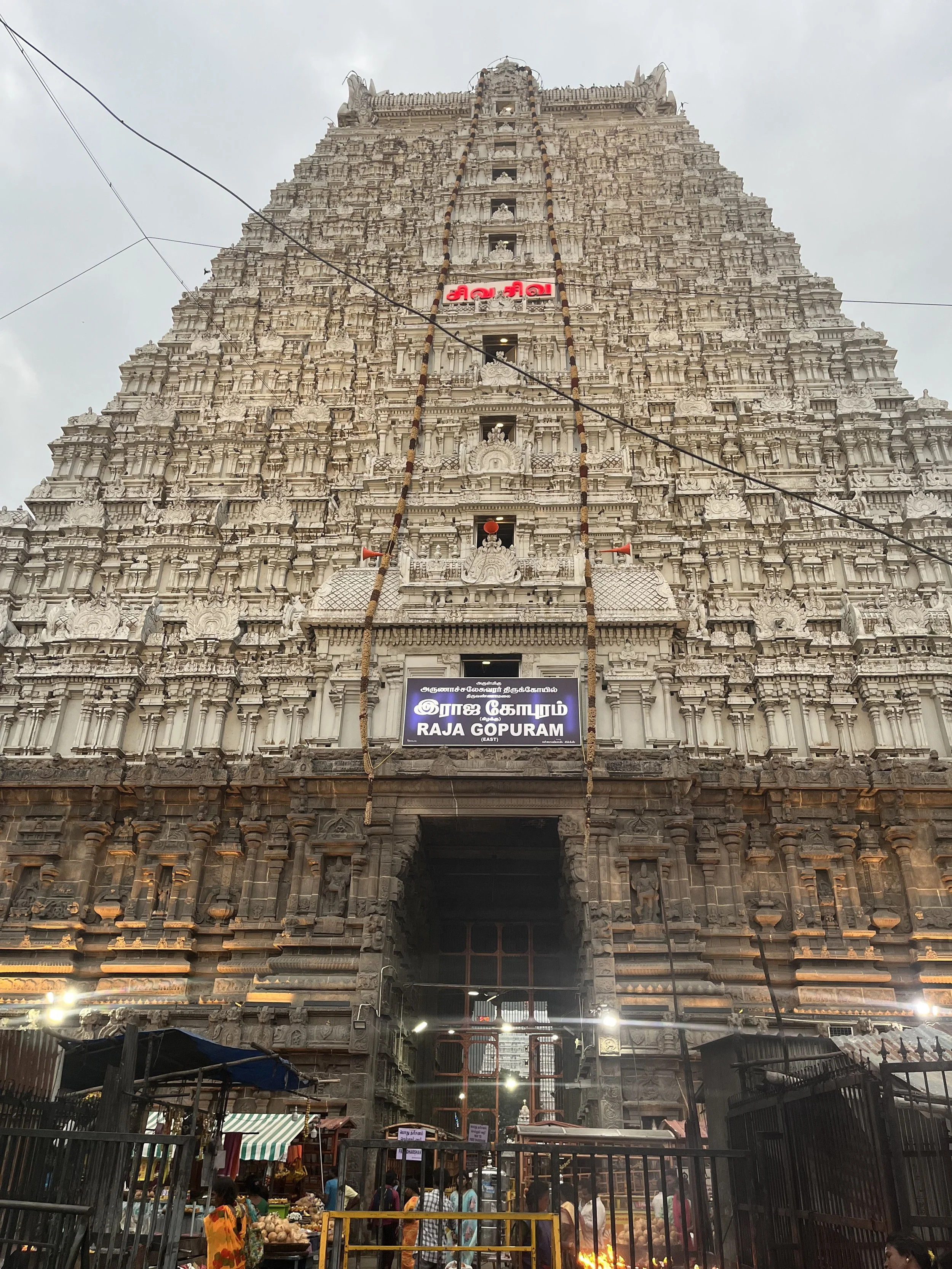
At the base of the hill, just past the Agni Lingam temple (which we visited many times), we returned to what quickly became our go-to sanctuary: The German Bakery.
This wasn’t just a café.
It was a pause. A pattern. A place to land between temple portals and barefoot prayers.
We’d sit there in the shade, sipping fresh juices and health tonics, eating simple vegetarian dishes — always nourishing, never too much.
But the star?
Ragi bread.
Dense, brown, and faintly nutty, this bread is made from finger millet flour — an ancient grain rich in iron and minerals, beloved in South Indian kitchens.
It held weight and warmth. It held us.
It’s funny how a place like that becomes part of your rhythm — not for the novelty, but because your body knows what it needs after walking through sacred fire.
3:30am Determination – The Girivalam Walk
Later that evening, after a full day on our feet, we made a decision:
We would walk the Girivalam the next day.
For those who don’t know, Girivalam is a 14km barefoot circumambulation of the holy mountain Arunachala — a devotional practice done by thousands each month, especially on full moon nights. But in Tiru, it never really stops.
We agreed to meet at 3:30am, hoping to beat the heat and the crowds.
And off we went.
Barefoot.
There’s No Way to Describe It
It’s hard to put into words. We walked in silence for a long time, giving coins to beggars along the way.
The stillness, the life, the rhythm of people walking through the dark —
some in silence, all with intention and reverence.
There was always chai somewhere.
There were always people.
Young men. Old women. Families with toddlers. Monks. Vendors.
People walking alone. People walking together. People walking for someone they lost.
The Field was alive.
But by the time we reached the downtown stretch, I was feeling…
some kind of way.
My feet were done.
But my heart was not.
And so we finished.
Aftermath and Integration
My feet needed serious attention.
Which they got. Every day after that.
But what happened on that hill — and on that long loop around the mountain —
wasn’t about the physical.
It was something else.
Something I still haven’t named.
Something I think only the mountain knows.
🛍️ Every Day, A Little More Familiar
By the end of that 2nd day, we had our rhythm.
We knew where to go, how to walk, when to eat — and even who to greet.
A few shopkeepers began recognizing us with a smile and a wave.
A soft kind of familiarity settled in — one that said: You belong here now.
And yes — there was always a shopping opportunity.
Everyone in India has a shop! Or simply something to sell on the roadside.
I found an incredible pashmina, soft and rich and real — not overpriced or performative, but authentic high quality and craftsmanship, the way it should be.
I picked up a few pieces of quality clothing that would’ve cost 10x as much at home — items made with care, not trend.
And the jewelry? Semi-precious stones like alexandrite, quietly tucked in cases, offered at a fraction of what they’d cost here — no fanfare, no extreme markup, just stones with stories.
It wasn’t about collecting.
It was about recognizing resonance — and bringing home the pieces that mirrored the shift already happening inside.
Coming Soon:
Part 3 — The Beauty I Forgot at Home
On returning to the West, the ache of contrast, the truth of what you can’t unsee, and what sacred rhythm still lives in the body — even when you leave the mountain.